
What Is a GCLID? Every Ad Click ID Explained (2026)
A GCLID is the click ID Google Ads adds to your ad URLs. Learn what GCLID, GBRAID, FBCLID, MSCLKID and TTCLID do, where they get lost, and how to keep them.
·
18 min read
 SignalBridge
21 articles about google ads
A GCLID is the click ID Google Ads adds to your ad URLs. Learn what GCLID, GBRAID, FBCLID, MSCLKID and TTCLID do, where they get lost, and how to keep them.

Google Ads vs Microsoft Ads: compare CPC, attribution, and server-side tracking to see where ROAS really comes from, with 2026 data. See the numbers.

Set up Google Ads conversion tracking step by step: create the action, install the Google tag, choose counting and windows, verify it, and close the gaps.

Audit your Google Ads account for bot traffic: check invalid clicks, conversion timing, placements, locations and Smart Bidding trends, then filter bot events server-side.

Google Performance Max campaigns depend on high-quality conversion data. Learn how server-side tracking fixes the data gaps that cause PMax to underperform.

Learn how to track recurring subscription revenue, rebills, and SaaS conversions using server-side events on Meta CAPI, Google Ads, and TikTok.

Learn how to set up accurate ad attribution for your Shopify store. Discover why Shopify's native reporting misses conversions, how to fix attribution gaps, and how to know exactly which ads generate real revenue.

Compare the best tools for implementing Google Enhanced Conversions in 2026. From free options like Google Tag Gateway to managed platforms like SignalBridge, find the right fit for your business and budget.

Ad blockers and iOS privacy are inflating your CPA by hiding real conversions. Learn how server-side tracking recovers lost data and reduces cost per acquisition by 20-40% across Meta, Google, and TikTok.

Offline conversion tracking explained: how to send in-store purchases, phone leads, and CRM closes back to Facebook, Google, and TikTok using server-side data and the Conversions API.

Client-side vs server-side tracking explained: how each works, where each fails, a side-by-side comparison, and why a hybrid setup is most reliable in 2026.

Multi-touch attribution explained for e-commerce marketers. Learn how MTA models work, why single-touch attribution is costing you money, and how to implement attribution that reflects reality.

How marketing agencies can implement server-side tracking across client accounts. Scale Meta CAPI, Google Enhanced Conversions, and TikTok Events API without managing individual server infrastructure.

Set up server-side tracking on WooCommerce for Facebook CAPI, Google Enhanced Conversions, and TikTok Events API. Recover 20-40% of conversions lost to ad blockers and iOS privacy restrictions.

Your Facebook, Google, and TikTok ads are underreporting conversions by 15-30%. Learn the 3 reasons your tracking pixel is broken, how to diagnose the gap, and what to do about it.

Set up server-side tracking on Shopify for Facebook CAPI, Google Enhanced Conversions, and TikTok Events API. Now available as an official Shopify App Store app — install in one click.

Consent Mode v2 lets you track conversions even when users decline cookies — legally. Learn how it works, the difference between Basic and Advanced mode, and how it pairs with server-side tracking for complete GDPR-compliant attribution.
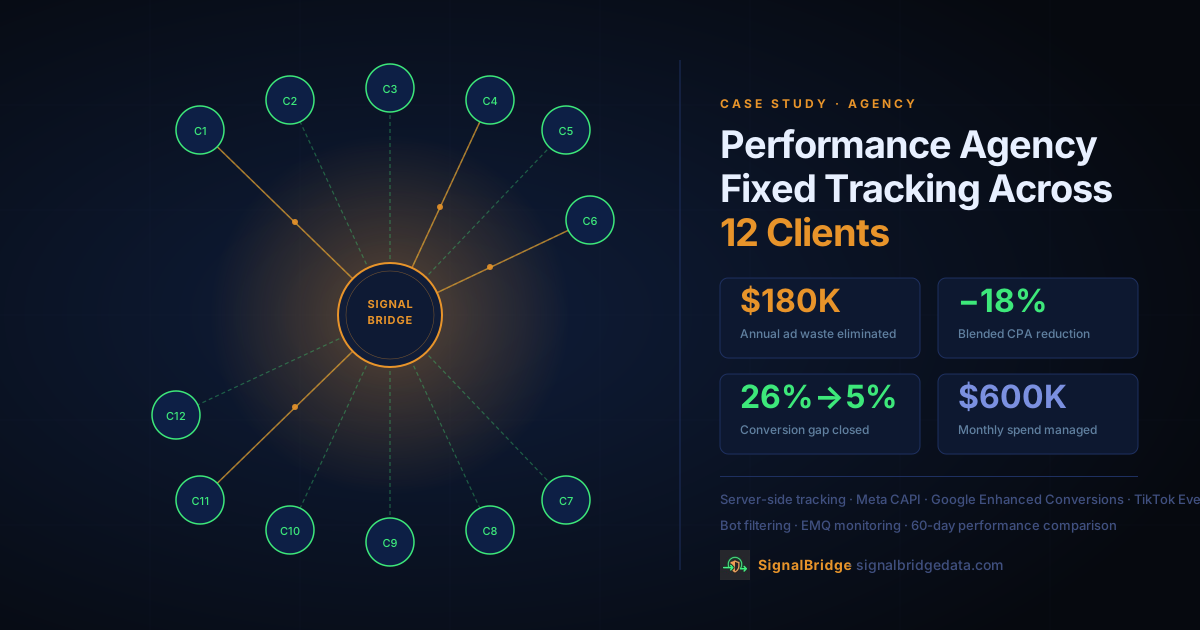
A performance marketing agency managing $600K/month in ad spend across 12 e-commerce clients used server-side tracking to close conversion gaps averaging 26%, reduce blended CPA by 18%, and eliminate the monthly 'numbers don't match' client calls.
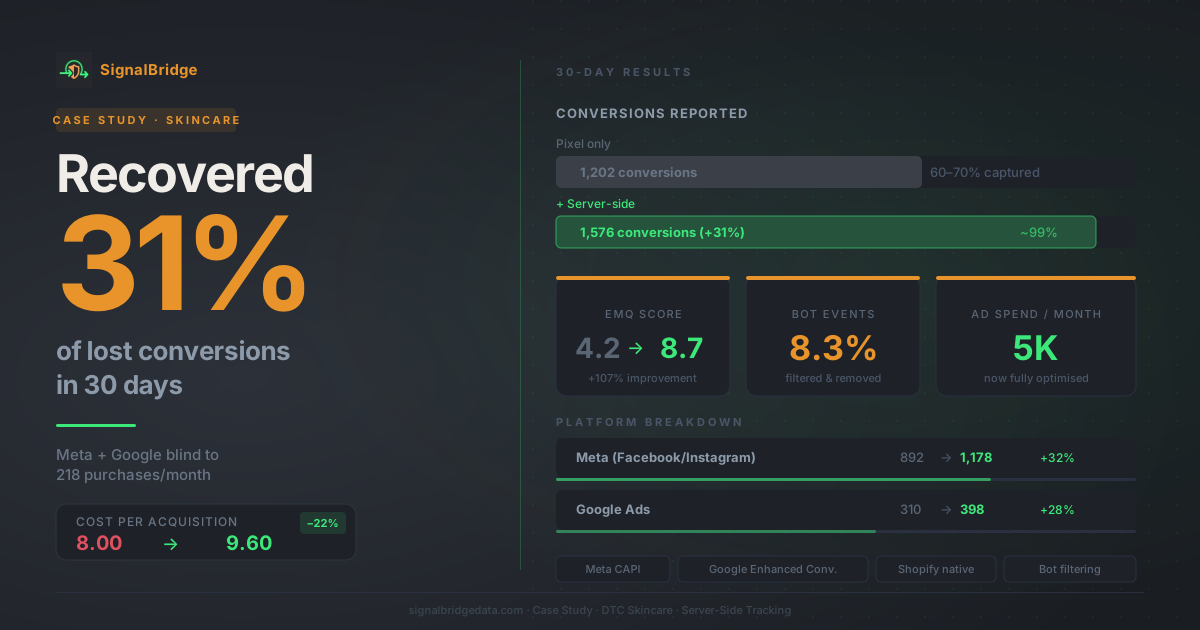
A direct-to-consumer skincare brand spending $45K/month on Meta and Google Ads recovered 31% of lost conversions after switching from pixel-only tracking to server-side tracking with SignalBridge. Their true CPA dropped from $38 to $29.60 in 30 days.

Step-by-step guide to setting up Google Enhanced Conversions for web and leads. Recover lost conversions, improve Smart Bidding, and get better ROAS from Google Ads.

Facebook says 50 conversions. Google says 35. Your Shopify dashboard says 42. Learn why cross-platform attribution numbers never agree, what each platform counts differently, and how to find the truth.