 SignalBridge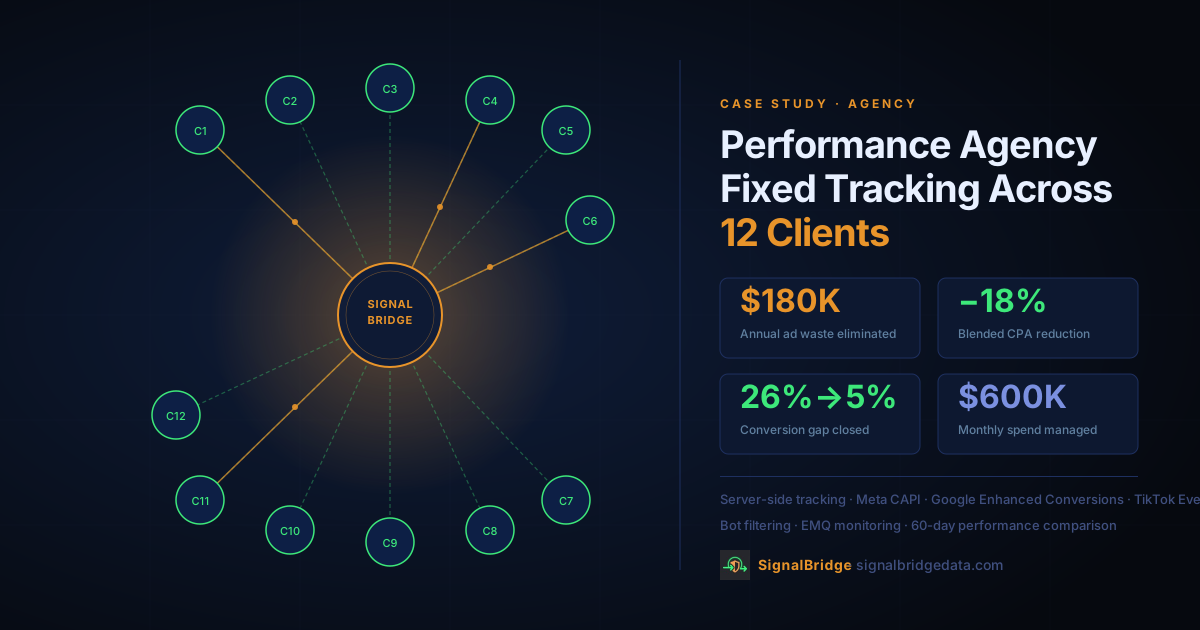
The Challenge
Agency profile: A 6-person performance marketing agency specializing in paid acquisition for e-commerce brands. They manage Meta Ads, Google Ads, and TikTok Ads across 12 clients.
Total managed spend: $600,000/month across all clients
The recurring problem: Every single client had the same issue — their e-commerce backend (Shopify, WooCommerce, or BigCommerce) showed more orders than Meta and Google reported. The gap varied from 15% to 41% depending on the client.
The monthly reporting nightmare
| Client | Vertical | Monthly Spend | Backend Orders | Platform Reported | Gap |
|---|---|---|---|---|---|
| Client A | Supplements | $85K | 2,840 | 1,988 | 30% |
| Client B | Fashion | $72K | 1,920 | 1,632 | 15% |
| Client C | Home goods | $65K | 890 | 596 | 33% |
| Client D | Pet products | $55K | 1,650 | 1,122 | 32% |
| Client E | Beauty | $48K | 1,280 | 998 | 22% |
| Client F | Fitness | $45K | 760 | 448 | 41% |
| Client G | Kids/baby | $42K | 1,100 | 836 | 24% |
| Client H | Food/bev | $38K | 2,200 | 1,804 | 18% |
| Client I | Jewelry | $35K | 420 | 311 | 26% |
| Client J | Outdoor gear | $42K | 680 | 476 | 30% |
| Client K | Tech accessories | $40K | 1,540 | 1,063 | 31% |
| Client L | Wellness | $33K | 890 | 676 | 24% |
| Average | $50K | 26% |
Every month, the agency spent 2–3 hours per client reconciling numbers, explaining attribution gaps, and defending campaign performance. That's 24–36 hours of senior team time spent on a problem that couldn't be solved with better reporting — it required better data. Server-side tracking with proper bot filtering and EMQ optimization was needed.
Why it mattered beyond reporting
The conversion gap wasn't just a reporting annoyance. It had three concrete business consequences:
-
Budget misallocation — Without complete conversion data, the agency couldn't accurately calculate ROAS per campaign. They were pausing campaigns that were actually profitable and scaling campaigns that looked good only because the comparison was skewed.
-
Algorithm underperformance — Meta and Google's algorithms were optimizing based on 74% of reality. They were learning from an incomplete and biased dataset, which meant ad delivery was suboptimal across all clients.
-
Client churn risk — Three clients had expressed frustration about "paying for results we can't verify." One was actively considering bringing media buying in-house.
The Solution
The agency rolled out SignalBridge across all 12 clients over two weeks, starting with the three highest-spend accounts and working down.
Rollout timeline
| Week | Action |
|---|---|
| Week 1 | Implemented SignalBridge on Clients A, B, C (highest spend) |
| Week 1–2 | Connected Meta CAPI, Google Enhanced Conversions, TikTok Events API |
| Week 2 | Implemented on Clients D–L |
| Week 2–3 | Enabled bot filtering across all accounts |
| Week 3–4 | EMQ scores stabilized across all clients |
| Week 5–8 | Full performance comparison against previous 8 weeks |
What the agency valued
The agency chose a managed platform over DIY sGTM for specific operational reasons:
- One platform, 12 clients — A single dashboard to monitor all accounts
- No GTM maintenance — No server containers to patch, no tag configurations to debug
- Consistent implementation — Same setup process for Shopify, WooCommerce, and BigCommerce
- Bot filtering included — Didn't need a separate click fraud tool
- EMQ monitoring — Real-time tracking health alerts without logging into each Events Manager
The Results
Aggregate 60-day results across all 12 clients
| Metric | Before (Pixel Only) | After (Pixel + SST) | Change |
|---|---|---|---|
| Total backend orders/month | 16,170 | 16,420 (seasonal) | — |
| Total platform-reported conversions | 11,950 | 15,248 | +27.6% |
| Average conversion gap | 26% | 5.2% | -80% reduction |
| Blended CPA | $50.21 | $41.17 | -18.0% |
| Bot events filtered/month | 0 | 1,494 | 9.1% of events |
| Average EMQ (Meta) | 4.8 | 8.4 | +75% |
Per-client conversion gap reduction
| Client | Gap Before | Gap After | Conversions Recovered/mo |
|---|---|---|---|
| Client A | 30% | 4% | 738 |
| Client B | 15% | 3% | 230 |
| Client C | 33% | 6% | 240 |
| Client D | 32% | 5% | 446 |
| Client E | 22% | 4% | 230 |
| Client F | 41% | 8% | 251 |
| Client G | 24% | 5% | 209 |
| Client H | 18% | 3% | 330 |
| Client I | 26% | 5% | 88 |
| Client J | 30% | 6% | 163 |
| Client K | 31% | 5% | 401 |
| Client L | 24% | 4% | 191 |
| Total | 26% avg | 5.2% avg | 3,517 |
The remaining 5.2% gap is expected — it represents conversions that genuinely can't be attributed (e.g., users who clear cookies between sessions, offline conversions, gift card purchases where the buyer isn't the clicker). Server-side tracking can't recover conversions that have zero digital touchpoints.
Why Client F had the biggest gap (and recovery)
Client F (fitness equipment, $45K/month spend) had a 41% conversion gap — the worst in the portfolio. Investigation revealed:
- 78% of their traffic was from iOS devices (fitness audience skews young/mobile)
- Their average purchase cycle was 8.2 days (expensive equipment = longer consideration)
- Their audience was 72% male aged 25–34 (the demographic with highest ad blocker usage)
All three signal loss factors (iOS, cookie expiration, ad blockers) were hitting this client at maximum impact simultaneously. After server-side tracking, their gap dropped to 8% — recovering 251 monthly conversions that were previously invisible.
Financial Impact
Direct savings from bot filtering
Bot filtering across 12 clients removed 1,494 fake events per month. At an estimated $1.20 per wasted click/event, that's approximately $1,793/month or $21,500/year in ad spend that was being wasted on non-human traffic.
CPA efficiency gains
The 18% CPA reduction across $600K/month in spend translates to:
| Metric | Monthly | Annual |
|---|---|---|
| Ad spend saved at same volume | $12,780 | $153,360 |
| Bot waste eliminated | $1,793 | $21,516 |
| Total efficiency gain | $14,573 | $174,876 |
Client retention
The three at-risk clients renewed their contracts after seeing the reconciled conversion data. The agency estimated that retaining those accounts preserved approximately $200K/year in agency revenue.
Agency operational savings
The monthly reconciliation process dropped from 24–36 hours to approximately 4 hours (spot-checking the small remaining gap). At $150/hour loaded cost, that's $3,000–$4,800/month in recovered senior team time that could be redirected to strategy and optimization.
Key Learnings
1. The gap varies dramatically by audience composition
Client B (fashion, younger female audience, mobile-heavy) had a 15% gap. Client F (fitness equipment, male 25–34, long purchase cycle) had a 41% gap. Understanding the audience profile predicts how much conversion data you're losing.
2. Bot traffic was worse than anyone assumed
9.1% of events being fraudulent was a surprise. The agency had assumed click fraud was a problem they'd mostly solved with platform-side invalid click detection. The reality: platforms catch obvious bots but miss sophisticated automated traffic that triggers mid-funnel events.
3. EMQ improvement was the biggest performance lever
The jump from EMQ 4.8 to 8.4 (aggregate across clients) had more impact on CPA than any creative or targeting optimization the agency had done in the previous quarter. Better data quality beat better creative.
4. Standardization matters for agencies
Having one platform across all clients, all e-commerce platforms, and all ad channels eliminated the technical debt of managing 12 different tracking setups. The agency could onboard a new client with server-side tracking in under an hour.
FAQ
Can an agency manage multiple client accounts from one place?
Yes. SignalBridge supports multiple pixels and accounts, making it practical for agencies managing portfolios of clients. Each client gets their own tracking setup with separate data.
Does this work for clients on different e-commerce platforms?
Yes. The implementation works the same way across Shopify, WooCommerce, BigCommerce, and other platforms. The pixel script install is platform-agnostic.
What if a client wants to bring tracking in-house later?
Server-side tracking through SignalBridge doesn't create vendor lock-in on the ad platform side. The Meta CAPI, Google Enhanced Conversions, and TikTok Events API connections work through standard APIs. If a client moves to a different solution, their ad platform configurations remain intact.
How does pricing work for agencies with multiple clients?
Each client account is billed separately based on their event volume. The agency doesn't need a special enterprise plan — each client subscribes at the plan tier that matches their traffic.
What was the most common pushback from clients during rollout?
Privacy concerns. Two clients asked about data handling. The answer: all PII is hashed (SHA-256) before being sent to ad platforms. Raw emails and phone numbers never leave the client's domain unhashed. This satisfied both clients' legal teams.
Ready to close the conversion gap for your clients?
SignalBridge gives agencies a single platform for server-side tracking across all clients and ad platforms — with bot filtering, EMQ monitoring, and true ROAS reporting built in.
Start your free trial today — no credit card required.
Related Articles
Case Study: How a DTC Skincare Brand Recovered 31% of Lost Conversions and Cut CPA by 22%
A direct-to-consumer skincare brand spending $45K/month on Meta and Google Ads recovered 31% of lost conversions after switching from pixel-only tracking to server-side tracking with SignalBridge. Their true CPA dropped from $38 to $29.60 in 30 days.
Best Server-Side Tracking Tools for Agencies in 2026 (7 Platforms Compared)
Compare the 7 best server-side tracking tools for agencies managing multiple clients. Pricing, multi-client features, white-labeling, and which platform fits your agency.